This handbook for holistic urban design is inspired by A Pattern Language. It grows chapter by chapter. Its becoming a valid shared reference for anyone working on the transformation of cities.
The guiding principle for Beautiful Cities
Cities are more than infrastructure, buildings and regulations.
They are lived systems shaped by everyday encounters, shared spaces and a sense of belonging.
Beautiful cities emerge where people feel connected to their surroundings and to each other – where urban space supports social life instead of fragmenting it.
Beautiful Cities are shaped by values – not as abstract ideals, but as practical principles that guide design, governance and everyday decisions.
These principles describe how we build cities that support life, dignity and belonging. They are the foundation on which all other frameworks, processes and tools can grow.
Beauty – creating places that inspire, heal and connect
We believe in cities that feel human, inviting and emotionally nourishing. Beauty is not decorative; it is essential for dignity, belonging and mental health.
What does ‘beautiful’ mean in a city?
Beauty in cities is not a fixed form or a universal style. It is experienced – not prescribed.
A helpful starting point is a simple question:
Which place would I recommend to a visitor in my city?
Or: Where is my favourite place nearby – and why?
These questions reveal personal images of what makes a city feel beautiful. They show that beauty is subjective – yet not arbitrary.
Across cultures and contexts, recurring patterns emerge.
Beauty as a shared urban quality
The New European Bauhaus describes beauty as more than appearance.
Beautiful means inclusive and accessible spaces, where dialogue between different cultures, disciplines, genders and ages becomes an opportunity to imagine a better place for all. It also means a more inclusive economy, where wealth is shared and spaces remain affordable.
Beautiful means sustainable solutions that create a dialogue between the built environment and the planet’s ecosystems. It means regenerative approaches inspired by natural cycles that replenish resources and protect biodiversity.
Beautiful means enriching experiences that respond to needs beyond the material dimension – inspired by creativity, art and culture. It means appreciating diversity as an opportunity to learn from each other.
These dimensions capture something essential: beauty is relational. It connects people to places, to each other and to the world around them.
From concrete to care
Beauty becomes tangible when cities transform spaces that divide into spaces that connect. A traffic-dominated concrete corridor turned into a green, walkable park strip does more than improve appearance. It changes how people move, meet, pause and care. Such transformations show that beauty is not a luxury. It is a catalyst for health, belonging and shared responsibility.
Beauty without uniformity
There is no single definition of a beautiful city. But there are shared qualities that many people recognise as beautiful.
These include:
- human scale
- care and maintenance
- access and openness
- places that invite people to stay
- spaces that feel alive, safe and meaningful
Beautiful Cities do not impose one image. They create the conditions for many forms of beauty to emerge.
This includes:
- streets and squares that feel safe, open and alive
- architecture and public spaces that reflect care, creativity and local identity
- environments where children, elders and everyone in between can thrive
Beautiful cities strengthen the soul of a community. They make people want to care for what they build together.
Togetherness – co-creation, community and accountability
We build cities with people, not for them. True urban transformation grows from participation, dialogue and shared ownership.
Togetherness means:
- learning from each other across regions, cultures and disciplines
- creating low-threshold spaces for collaboration and cooperation
- valuing lived experience alongside professional expertise
- developing solutions that reflect shared goals rather than individual interests
No single actor can solve urban challenges alone. Together, we create cities that are more resilient, more just and more compassionate.
Care – the social foundation of safety and resilience
Beautiful Cities are shaped by care. Care is expressed in how we design spaces, maintain streets, organise neighbourhoods and take responsibility for shared places. Cities designed with care reduce isolation, strengthen trust and support everyday well-being.
Where people feel seen, safe and connected:
- loneliness decreases
- health improves
- social tensions ease
- democratic resilience grows
Safety and resilience are not the starting point. They are outcomes of cities designed around people, visibility and mutual care.
Sustainability – living within our ecological boundaries
We commit to shaping cities that respect our planet and protect our life-support systems we depend on.
This means:
- designing urban spaces that reduce emissions, protect biodiversity and restore nature where possible
- promoting active mobility, healthy streets and climate-resilient neighbourhoods
- supporting choices that strengthen long-term ecological balance and human well-being
Sustainability is not an add-on. It is the foundation for urban life – today and for future generations.
Our overarching principle: cities shaped by care
Where we live shapes how we live. Cities shaped by care create communities that care for each other. They support everyday connection, shared responsibility and the capacity to face change together.
For situations where complexity, scale or risk exceed what informal structures can handle, complementary safety frameworks are needed.
A broader perspective on systemic risks – including climate emergencies, infrastructure failures and democratic erosion – is addressed through Holistic Safety.
Beautiful Cities begin before emergency planning and technical frameworks. They begin with values that make belonging possible.
Ethical and legal foundations
Beautiful Cities are guided by clear values – and grounded in widely shared ethical and legal frameworks. Our work is informed by human rights, social responsibility and the recognition of planetary limits. These foundations are not abstract ideals. They define the minimum conditions for a dignified life in cities.
A critical ethical perspective
There is no right life in the wrong one.
Theodor W. Adorno
This sentence reminds us that urban design, governance and economic choices are never neutral. Cities can normalise injustice – or help overcome it. Beautiful Cities do not aim to optimise a flawed system, but to question structures that undermine dignity, health and belonging.
United Nations – Sustainable Development Goals
The Sustainable Development Goals (SDGs) of the United Nations form an important reference for our work, particularly those addressing sustainable cities, health, equality and environmental protection.
However, we consciously distance ourselves from a growth-centred interpretation of sustainability. Especially SDG 8, with its focus on economic growth, does not align with our understanding.
From our perspective, the future of cities depends less on continued economic growth and more on:
- careful use of resources
- respect for ecological limits
- regeneration instead of extraction
- well-being instead of throughput
Sustainability means learning to live well within our means – socially and ecologically.
European Union – Charter of Fundamental Rights
At European level, our work is grounded in the Charter of Fundamental Rights of the European Union, in particular:
- Article 24 – Rights of the child
Cities must be designed so that children can move, play and grow safely and independently. - Article 25 – Rights of the elderly
Urban environments must support autonomy, accessibility and participation throughout the entire life course. - Article 26 – Integration of persons with disabilities
Accessibility and inclusion are not optional features, but fundamental rights. - Article 35 – Health care
Urban design has a direct impact on physical and mental health and must actively support health protection. - Article 36 – Environmental protection
Cities carry responsibility for protecting natural resources and life-support systems for present and future generations.
These rights provide a clear orientation: cities are not machines for efficiency, but environments for human life in all its diversity.
A hidden but decisive crisis: loneliness
Beyond climate stress, pollution and housing pressure, cities face another crisis that increasingly shapes health and society: loneliness.
Loneliness affects mental and physical health and is associated with higher mortality risk. The signs have been visible for years, yet as a society we have done too little to address them. One reason is stigma: loneliness is often treated as a personal weakness instead of a shared societal challenge.
Its drivers are deeply connected to how cities are built and governed:
- the decline of community structures and everyday meeting places
- changing work patterns, including remote work
- increased time spent on smartphones and social media
- ongoing uncertainty, worry and a sense of loss that lead people to withdraw
Beautiful Cities treat loneliness not as a private issue, but as a design and governance question. Cities can reinforce isolation – or they can create the conditions for connection.
Human-scale neighbourhoods, walkable streets, welcoming public spaces and meaningful local participation are not “nice extras”.
They are part of a public health response and a foundation for resilient communities.
Belonging, loneliness and democratic resilience
Loneliness and loss of belonging do not only affect individual well-being. They also affect how societies function – and how vulnerable they become to anti-democratic and authoritarian movements.
When people feel unseen, unheard or disconnected, trust in institutions and democratic processes erodes. In such situations, simple explanations and clear enemies become attractive. Authoritarian narratives offer easy answers to complex problems, shift blame onto others and promise relief without personal responsibility or shared effort.
This dynamic is not primarily ideological. It is deeply human.
People who feel they do not belong anywhere are more likely to seek belonging elsewhere – even in movements that undermine openness, pluralism and democracy itself.
Cities therefore play a critical role in democratic resilience.
Urban environments that isolate people, fragment everyday life and reduce opportunities for meaningful encounter unintentionally strengthen the conditions in which radicalisation can grow.
Beautiful Cities counter this dynamic at its root – by fostering:
- human-scale neighbourhoods
- shared public spaces
- everyday dialogue
- visible and meaningful participation
Democratic resilience is not created by laws alone. It grows where people experience agency, dignity and belonging in their daily lives.
Health, environment and social life belong together
Many of today’s urban challenges are deeply interconnected:
- health impacts from passive mobility (air pollution, noise)
- heat stress and extreme weather events
- social isolation and loneliness
- declining trust and democratic fatigue
These are not separate problems.
They all point to the same underlying need: a people-centred transformation of our cities.
Streets designed for movement instead of life, housing that exceeds human scale, and fragmented urban structures amplify these stresses. Cities that prioritise human-scale design, active mobility, greenery, water, shade and everyday encounter address multiple challenges at once.
Structural conditions for living together
Good social life does not emerge by chance.
It depends on fundamental spatial conditions.
Three factors are particularly decisive:
Human-scale housing
Housing shapes everyday life more than any other urban element. Buildings that remain close to human scale — with visible entrances and manageable numbers of residents — support orientation, social contact and a sense of responsibility. Large, anonymous structures may be efficient on paper, but often weaken social cohesion.
Streets as connectors — or barriers
Streets can connect people or separate them. Highly trafficked roads often cut through neighbourhoods like physical and social barriers. Beautiful Cities treat streets not only as transport corridors, but as public spaces that shape relationships, trust and everyday life.
beauty as social prevention
The influence of our environment on human behaviour is well established. Research on social order in public space has shown that visible signs of neglect – such as litter, vandalism, broken infrastructure or poorly maintained buildings – weaken the sense of social care and informal social control, making destructive behaviour more likely.
This is not a question of origin, culture or “certain groups”. It is a universal psychological and sociological pattern: When public space looks neglected, the social climate changes – often without people noticing it consciously.
Multiple research teams have demonstrated that disorder and neglect can:
- reduce trust in community and institutions
- lower willingness to cooperate and show consideration
- increase norm violations
- intensify social tensions
These effects occur across ages, incomes, backgrounds and education levels.
This creates a clear responsibility for cities and public authorities: Not only to provide functioning infrastructure, but also to maintain environments that are visibly cared for, safe and inviting. A beautiful, clean and well-designed city is more than aesthetics. It is a social protection system. Well-maintained spaces send a simple, powerful signal: Here we care. Here respect matters. Here everyone belongs. They strengthen belonging, dignity and shared responsibility – and therefore the social foundations on which resilient and democratic communities depend.
Readable urban structure
People need a city they can understand. Clear spatial units – from city to urban quarters, neighbourhoods and streets – help people know where they belong, where decisions are made and where they can contribute. Structure is not bureaucracy; it is what turns a collection of buildings into a place where people belong.
Why this matters
Urban design, governance and participation are never neutral. They either weaken or strengthen health, social cohesion and democracy – quietly, every day. Beautiful Cities strengthen democracy not through slogans, but by making people feel that they matter.
They are built on:
- human-scale spaces
- identifiable neighbourhoods
- shared responsibility
- dialogue instead of distance
- care instead of control
These principles form the foundation on which everything else can grow.
For situations where complexity, scale or risk exceed what informal structures can handle, complementary safety frameworks are necessary. A broader perspective on systemic risks – including climate emergencies, infrastructure failures and democratic erosion – is addressed through Holistic Safety.
But Beautiful Cities begin before technical frameworks and emergency planning. They begin with the conditions that allow people to belong.
governance
Direction, participation and responsibility
Leadership and participation are not opposites
Beautiful cities are not created by participation alone – nor by authority alone.
In many situations, strong political leadership can enable rapid and effective change. Clear goals, courageous decisions and consistent implementation at city level can transform streets, mobility and public space far more quickly than long participatory processes that risk losing momentum. Experience from cities such as Paris shows that decisive top-down action can open new possibilities for urban life.
At the same time, cities cannot thrive through top-down decisions alone. Urban quality is lived locally. Acceptance, care and long-term success depend on how changes are adapted, shaped and maintained at neighbourhood and street level.
The most effective approach therefore combines both dimensions:
- clear orientation, rules and boundaries from above, and
- local knowledge, ownership and adaptation on the ground.
City leadership sets the framework and creates room for change.
Communities, neighbourhoods and local actors fill this space with everyday life.
This balance avoids two common pitfalls:
- paralysis through endless participation without decision, and
- resistance caused by change imposed without connection to local reality.
Beautiful cities emerge where direction is set at city level,
and solutions are developed, tested and refined locally.
Accountability as the core of good governance
Good governance does not fail because of a lack of participation or regulation. It fails when nobody is clearly responsible.
Without unambiguous accountability, cities fall into a familiar pattern:
- responsibilities remain diffuse,
- decisions are replaced by procedures,
- processes are repeated “as always”,
- and nothing fundamentally improves.
In such situations:
- good laws are ignored because no one feels responsible for applying them,
- poor or outdated rules are implemented mechanically, without reflection,
- new knowledge is not integrated, and
- meaningful deviations are avoided — even when they are necessary and justified.
When everyone is ‘involved’, but no one is accountable, governance becomes symbolic. Activity replaces responsibility. Compliance replaces thinking. Beautiful cities require the opposite.
What accountability means in practice
Accountability means that for every relevant issue, it is clear and transparent:
- who is responsible,
- for what,
- at which level, and
- with which mandate to decide and adapt.
This does not reduce participation. It makes participation meaningful.
Clear responsibility:
- enables learning instead of blame-shifting,
- allows justified deviations instead of blind rule-following,
- connects local knowledge with formal authority, and
- turns governance from administration into stewardship.
Accountability is therefore not a technical detail. It is the condition that allows leadership, participation and adaptation to work together.
A foundation for all scales
This understanding of governance applies across all urban scales –
from city-wide frameworks to districts, neighbourhoods, streets and buildings. What accountability means will differ at each level. But without it, no level functions well.
Co-creation only works when the scale matches people’s lived reality. City-wide processes are necessary for strategy and fairness, but too abstract for everyday engagement. Neighbourhood-scale processes are tangible, understandable and motivating. Street-level actions allow people to see results quickly and build trust. When the scale is right:
- people feel competent to contribute
- dialogue becomes concrete
- responsibility feels manageable
- conflicts can be addressed constructively
When the scale is wrong, participation becomes performative and frustration grows. Beautiful cities respect scale because scale defines who can act, who feels responsible and who is heard.
hill of hysteria
Better to have a broad vision and a straight implementation plan, rather than implementing a little here and there:
accessibility – a human-centered perspective
Why accessibility matters
Accessibility is a prerequisite for participation in society. People need to reach everyday destinations – homes, schools, workplaces, shops, healthcare, social spaces and places of recreation – in a safe, dignified and reliable way.
The core question is not how fast traffic moves, but how easily people can reach what they need.
A city is not judged by how many highways it has,
Enrique Peñalosa, former Mayor of Bogotá
but by whether a child on a tricycle can move around safely and freely.
Cities that fail to ensure human-centred accessibility exclude people – quietly and systematically.
The problem: cities shaped by passive mobility
One of the main reasons why many cities feel hostile, stressful or unattractive is the dominance of cars.
Passive mobility – motorised individual transport – has shaped cities around movement instead of life. Its effects are well known:
- rising greenhouse gas emissions
- noise and air pollution
- high land consumption for moving and parked vehicles
- barriers between neighbourhoods
- reduced safety for children, older people and vulnerable groups
What is often framed as ‘efficiency’ comes at a high social, environmental and health cost.
Accessibility is not mobility
All people have a right to mobility – but mobility is not the goal. The goal is accessibility.
Accessibility asks different questions:
- Can daily needs be reached actively and safely?
- Are distances reasonable?
- Are routes understandable and inviting?
- Can people of different ages and abilities move independently?
When everyday destinations are accessible by foot, bicycle or public transport, mobility becomes part of daily life – not a burden, but a resource for health and well-being.
Active mobility integrated into everyday routines is one of the most effective and equitable public health measures available to cities.
Health, climate and accessibility belong together
The way cities organise accessibility directly affects:
- physical and mental health
- local air quality and noise exposure
- climate impacts at local and global scale
- social interaction and everyday encounter
These effects are cumulative.
They cannot be solved separately.
Cities that reduce passive mobility and prioritise active, human-scale accessibility address multiple challenges at once – health, climate, safety and social cohesion.
The question of costs and responsibility
Accessibility is also a question of fairness.
Transport systems generate very different social costs and benefits — yet these are rarely distributed fairly.
Passive mobility imposes significant external costs on society, including health impacts, infrastructure wear, land consumption and climate damage.
Human-centred accessibility requires:
- looking beyond construction costs
- accounting for long-term social and environmental impacts
- aligning who benefits with who bears the costs
- prioritising the common good and our shared life-support systems
Planning decisions must therefore look far into the future, not only at short-term efficiency.
Vision Zero as a guiding horizon
Human-centred accessibility is inseparable from safety.
Vision Zero – no deaths and serious injuries in traffic – must be understood broadly:
- no fatalities through collisions
- no long-term harm through noise and air pollution
- no acceptance of preventable health damage
Safety is not a constraint on accessibility. It is its ethical foundation.
From car-oriented to people-oriented cities
Cities of short distances are not a nostalgic idea.
They are a functional response to contemporary challenges.
Human-centred accessibility means:
- everyday destinations within active reach
- car-reduced residential areas
- safe and continuous walking and cycling networks
- priority for children, older people and people with limited mobility
- neighbourhood structures that discourage through-traffic
Reducing passive mobility is not about banning cars everywhere.
It is about restoring purpose, proximity and dignity to urban movement.
Accessibility as a shared responsibility
Accessibility is not only a technical issue.
It is a governance question.
It requires:
- clear priorities
- long-term commitment
- coordination across scales
- accountability for outcomes
Human-centred accessibility does not emerge by accident.
It is the result of deliberate choices about what – and whom – cities are built for.
A foundation for the scales of the city
Accessibility is shaped differently at each urban scale:
- within housing communities
- along streets
- across neighbourhoods
- at urban-quarter level
- and through city-wide networks
The following chapters explore how human-centred accessibility translates into concrete responsibilities, design choices and governance decisions at each scale.
scales of a city
The city as a system of scales
Cities function through a hierarchy of interconnected scales. Each scale plays a distinct role in governance, responsibility, design and participation. Cities work best when decisions are made at the right scale.
Why scale also matters for safety and resilience
Although Beautiful Cities focus on quality of life and social connection, scale also matters for how cities cope with disruption. Neighbourhoods are often the first level where problems appear – and the first where informal support emerges. Urban quaters coordinate resources and balance needs. Cities provide strategic capacity and long-term planning. Resilience grows when these levels reinforce each other, instead of working in isolation. Safety is not imposed from above. It grows from environments where people know each other, notice changes and care for their shared spaces.
The five urban scales
- housing community – shared living spaces and everyday neighbour relations within buildings or housing clusters
- street – the primary public space of daily movement, encounter and experience
- neighbourhood – a cluster of streets forming a socially experienced area of everyday life
- urban quarter – the level where multiple neighbourhoods are coordinated through services, infrastructure and planning
- city – the strategic and political level setting overall direction and responsibility
Each of these scales serves a different purpose. Clear governance, accountability, design and participation depend on understanding what belongs where.
When each level does what it does best, cities become:
- more human
- more adaptable
- more resilient — almost naturally
Beautiful cities begin at human scale – and grow outward from there.
housing community
What this scale is
The housing community is the smallest and most immediate scale of urban life. It includes shared entrances, staircases, courtyards, corridors and semi-private spaces where everyday encounters happen naturally. This is the scale where people either feel at home – or remain strangers.
Governance at this scale
Governance at housing-community level is primarily operational and relational. It concerns everyday rules, maintenance, shared use of spaces and the resolution of small conflicts.
Good governance here is simple, visible and fair. It does not rely on complex procedures, but on clear agreements and mutual respect.
Accountability and responsibility
Accountability at this scale must be unambiguous.
It needs to be clear:
- who is responsible for maintenance,
- who can decide on small changes,
- who mediates conflicts, and
- who represents the housing community towards higher levels.
Without clear responsibility, shared spaces deteriorate, conflicts accumulate and withdrawal increases. With clear accountability, everyday care becomes possible.
Design and spatial qualities
Design strongly influences social life at this scale.
Housing communities benefit from:
- visible and inviting entrances
- semi-private spaces that encourage casual encounters
- clear transitions between public, semi-public and private areas
- manageable building sizes that remain legible to residents
Human-scale housing supports orientation, responsibility and everyday care.
Participation and everyday practice
Participation at housing-community level is informal and continuous.
It happens through conversations, shared activities and small collective decisions.
Low-threshold formats work best:
- house meetings
- shared notice boards
- simple feedback channels
The goal is not constant engagement, but the ability to act together when needed.
streets
What this scale is
Street are the most immediate public space of the city. It is where urban life is touched, crossed, heard and felt. Streets shape how people move, meet and perceive their surroundings. They decide whether people slow down or rush through, feel welcome or excluded, stay attentive or disconnect. At this scale, the city becomes real.
Governance at this scale
Governance at street level is highly practical. It concerns how public space is used, shared and balanced between movement, safety, access and everyday life. Good street governance is visible and responsive. It allows adjustments, experiments and learning, instead of rigid optimisation for a single function. Streets require coordination between traffic management, public space design, maintenance and local needs – without losing sight of the human experience.
Accountability and responsibility
Accountability at street level must be clear and concrete. It needs to be evident who is responsible for the street space, who can initiate changes or trials, who evaluates impacts, and who responds when problems emerge. When responsibility is diffuse, streets default to inertia or one-dimensional use. When accountability is clear, streets can evolve. Street-level accountability enables learning, adaptation and justified deviation – instead of endless procedures or blind compliance.
Design and spatial qualities
Small design decisions at street level have immediate impact. Elements such as seating, shade, lighting, visibility, crossings, edges, greenery and water shape perception and behaviour instantly. They influence whether people linger or leave, feel safe or stressed, connect or withdraw. Street design works best when it prioritises human scale over traffic speed, makes movement and presence compatible, creates readable and inviting micro-spaces, and supports comfort, orientation and informal encounter. These interventions are often inexpensive, reversible and fast – yet highly effective.
Healthy Streets: A compass for wellbeing
The Healthy Streets approach is more than a technical framework; it is a lens through which we view the city through human eyes. Developed by Lucy Saunders, this tool centers on ten measurable indicators that determine whether we feel welcome, safe, and healthy in our streets. Instead of evaluating streets solely by their capacity for vehicle traffic, this approach asks: Does this space support human life? It provides a clear checklist for anyone looking to transform the public realm:
- Inclusivity for all
Does the street accommodate people from all walks of life—from a child on a balance bike to an elderly person with a walker? - Quality of experience
Is there shade, clean air, and places to rest and linger? - Intuitive safety
Do people feel relaxed? Is it easy to cross the street? Are there interesting things to see and do?
When we use these ten indicators as our benchmark, we transform infrastructure into living space. A “Healthy Street” is a place where we don’t just move through, but where we truly belong and thrive.
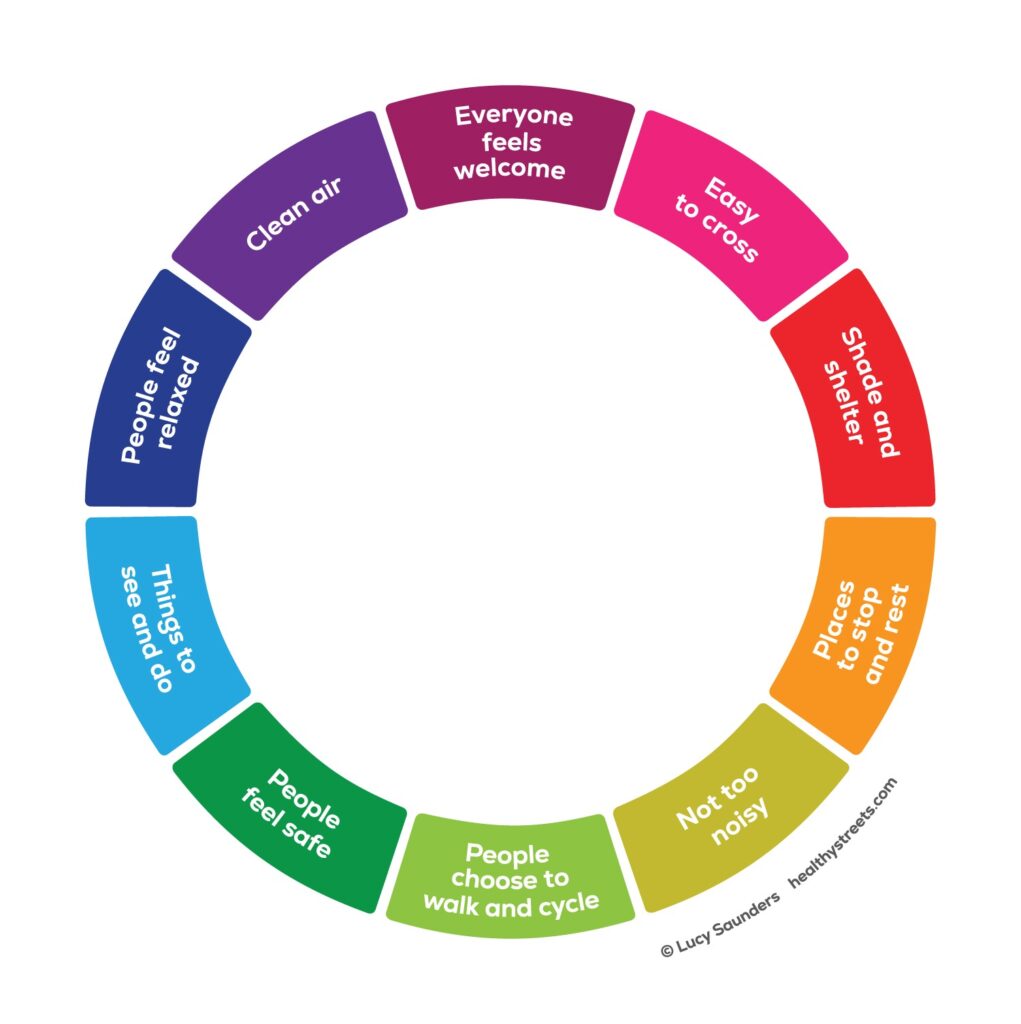
framework in action: The Good Street approach
To translate these values into practice, the use of the Good Street design approach is very meaningful. This framework helps to balance two often competing needs: Place (the quality of staying) and Flow (the movement of people and goods).
By categorizing streets not just by traffic volume, but by their social and ecological significance, the approach provides a clear roadmap for:
- Balancing movement and life
Ensuring that through-traffic doesn’t kill the “soul” of a street. - Safety by design
Using the principles of kinetic energy to create environments where human-scale mobility is naturally safe. - Context-sensitive solutions
Recognizing that a residential street needs different rules than a major urban connector.
Participation and everyday practice
Participation at street level works best when it is situational and concrete.
People can meaningfully engage when they recognise the place in question, see direct effects of change, and can give feedback based on everyday experience.
Temporary interventions, pilot projects and low-threshold dialogue formats allow streets to become shared learning spaces – not fixed outcomes.
Relation to other scales
Streets connect housing communities to neighbourhoods and urban quarters. They translate city-wide goals into lived experience and feed local observations back upward.
Well-functioning streets depend on supportive frameworks at higher scales – but they succeed or fail in everyday use.
neigbourhoods
What this scale is
Neighbourhoods are not only a spatial scale – they are a social principle. People need identifiable, walkable environments to belong to. Without a clear neighbourhood, responsibility becomes abstract and participation fades.
At neighbourhood scale:
- everyday life becomes visible
- problems are noticed early
- informal support emerges
- dialogue remains possible
- change can start with low effort
This is not nostalgia. It is functionality. The neighbourhood is the social scale of everyday urban life. It is where people recognise places, routines and often each other. Neighbourhoods are not defined by administrative boundaries, but by lived experience. They are walkable areas where daily needs overlap and where belonging can emerge naturally.
This is the scale where the city becomes familiar.
Governance at this scale
Governance at neighbourhood level is enabling and mediating.
Its role is not to control everyday life, but to support it.
Neighbourhood governance connects local knowledge with formal structures. It helps coordinate issues that go beyond a single street, while remaining close enough to everyday reality to stay grounded.
Good neighbourhood governance:
- supports local initiative without overburdening it
- resolves conflicts that cross street boundaries
- translates city-level goals into locally meaningful action
Accountability and responsibility
Accountability at neighbourhood level must be clear, visible and trusted.
It needs to be evident:
- who represents neighbourhood interests
- who can initiate or coordinate action
- who connects the neighbourhood to higher levels
- who is responsible when issues remain unresolved
Without clear responsibility, participation becomes symbolic and frustration grows. With clear accountability, neighbourhoods gain the capacity to act. Neighbourhood-level responsibility creates continuity – beyond individual engagement or short-term projects.
Design and spatial qualities
Neighbourhoods depend on spatial coherence.
They work best when:
- streets form a readable network
- public spaces invite everyday use
- barriers such as major traffic routes are minimised
- distances remain walkable and legible
Design at this scale shapes whether people feel oriented, safe and willing to engage. A well-designed neighbourhood supports informal encounters, shared care and everyday presence.
Lay out neighborhood roads so that they form loops. A loop is defined as any stretch of road which makes it impossible for cars that don’t have destinations on it to use as a shortcut. Do not allow any one loop to serve more than 50 cars, and keep the road really narrow – 17 to 20 m is quite enough.
Participation and everyday practice
Participation at neighbourhood level is relational and ongoing.
It is where dialogue becomes possible beyond isolated issues. People can engage meaningfully when they feel recognised and when participation connects to real decisions.
Effective neighbourhood participation:
- focuses on concrete places and issues
- values lived experience alongside expertise
- allows disagreement without escalation
- leads to visible outcomes
Neighbourhoods are the level where participation moves from consultation to co-creation.
Relation to other scales
Neighbourhoods connect housing communities and streets to urban quarters and the city as a whole.
They translate everyday experiences upward and provide context for decisions made at higher levels. At the same time, they rely on supportive frameworks, resources and mandates from above.
Neighbourhoods succeed when they are empowered – not isolated.
They are the scale where belonging, responsibility and democratic practice come together.
urban quarters
What this scale is
Urban quarters are the coordinating scale between neighbourhoods and the city as a whole. They group several neighbourhoods that share infrastructure, services and functional patterns.
This is the level where complexity increases – but everyday life must still remain visible.
Urban quarters are not primarily about identity. They are about coordination.
Governance at this scale
Governance at urban-quarter level is integrative and coordinating.
Its role is to align services, infrastructure and planning tasks that exceed neighbourhood scale, while respecting local diversity and identity.
Urban-quarter governance:
- connects multiple neighbourhoods without overriding them
- balances uneven resources and capacities
- coordinates schools, health services, mobility hubs, green corridors and local centres
- translates city-wide strategies into operational frameworks
Good governance at this scale enables neighbourhoods to function – instead of competing or fragmenting.
Accountability and responsibility
Accountability at urban-quarter level must be formal, explicit and stable.
It needs to be clear:
- who is responsible for coordination across neighbourhoods
- who holds decision-making authority for shared infrastructure and services
- who ensures that local needs are represented upward
- who is accountable when coordination fails
Without clear responsibility, problems are shifted sideways or upward – and remain unresolved. With clear accountability, urban quarters become reliable connectors between local life and city strategy.
This scale is critical to avoid the common governance gap where issues are “too big for neighbourhoods” and “too small for the city”.
Design and spatial qualities
Design at urban-quarter level focuses on coherence rather than detail.
Key aspects include:
- connectivity between neighbourhoods
- continuity of public spaces and green networks
- legible centres and service locations
- balanced distribution of functions and amenities
Well-designed urban quarters prevent isolation and inequality between neighbourhoods. They support access, orientation and fairness – without erasing local character.
Participation and everyday practice
Participation at urban-quarter level is representative and structured.
It cannot rely solely on informal engagement, but should remain connected to lived experience.
Effective participation at this scale:
- brings together voices from multiple neighbourhoods
- focuses on shared challenges and priorities
- allows negotiation and compromise
- feeds into binding decisions
Urban-quarter participation works best when it complements neighbourhood-level dialogue – not when it replaces it.
Relation to other scales
Urban quarters connect neighbourhood life with city-wide governance. They translate strategic goals into coordinated action and bring local realities back into higher-level decision-making. At the same time, they depend on clear mandates, resources and political backing from the city level.
Urban quarters succeed when they are strong enough to coordinate – and close enough to remain grounded.
city
What this scale is
The city is the strategic and political scale of urban life. It sets direction, priorities and boundaries for how the city develops over time. This is the level where collective goals are defined – and where responsibility ultimately rests.
Governance at this scale
Governance at city level is directional and enabling.
Its role is to provide clear frameworks within which lower scales can act effectively. This includes setting goals, legal conditions, standards, budgets and long-term strategies.
Good city governance:
- defines clear priorities
- creates consistency across sectors and departments
- allows flexibility and adaptation at lower levels
- enables learning instead of enforcing rigidity
City-level governance is successful when it empowers streets, neighbourhoods and urban quarters – not when it micromanages them.
Accountability and responsibility
Accountability at city level must be unmistakable and public.
It needs to be clear:
- who is politically responsible for outcomes
- who decides when trade-offs are necessary
- who accepts responsibility for unresolved risks
- who is accountable when goals are not met
At this scale, responsibility cannot be delegated away. While tasks can be distributed, accountability remains at city level.
Clear accountability prevents a common failure pattern:
everyone implements procedures, but no one owns the outcome.
Design and spatial qualities
Design at city level is not about individual spaces.
It is about coherence across the whole urban system.
City-level design concerns:
- the overall spatial structure
- mobility hierarchies
- land-use patterns
- green and blue networks
- relationships between density, access and quality of life
Well-designed cities align these elements into a readable and balanced whole – allowing local design to flourish within a clear framework.
If we look at the passive mobility and its space, we need to consider that experts expect by 2035 that most people who don’t want to get active around the city will use robo taxis.
Within a local transport area design no intersecting major roads leading in and out of a city at all. Instead, design a system of parallel and alternating one-way roads to carry traffic to the ring roads. Keep these parallel roads between 100 m and 400 m apart (to make room for neighborhoods between them) and the ring roads between 3 and 5 km apart.
Participation and decision-making
Participation at city level must be meaningful and connected to decisions.
It focuses on:
- setting shared goals
- negotiating priorities
- legitimising long-term strategies
- addressing conflicts that exceed lower scales
City-level participation works best when it is transparent about its scope and limits. Not every issue can be decided collectively – but the rules of decision-making must be clear. Deliberative formats, representative bodies and city-wide dialogues complement participation at lower levels, without replacing it.
Relation to other scales
The city level provides orientation for all other scales.
It enables housing communities, streets, neighbourhoods and urban quarters to function by:
- setting boundaries
- allocating resources
- resolving conflicts that cannot be solved locally
At the same time, the city depends on feedback from below. Without grounded experience, city strategies lose relevance.
Cities succeed when direction flows downward – and reality flows upward.
more to come
Learning, adaptation and justified deviation
Co-creation and citizens’ councils
Dealing with conflict and disagreement
good street design
a very helpful tool for urban design: